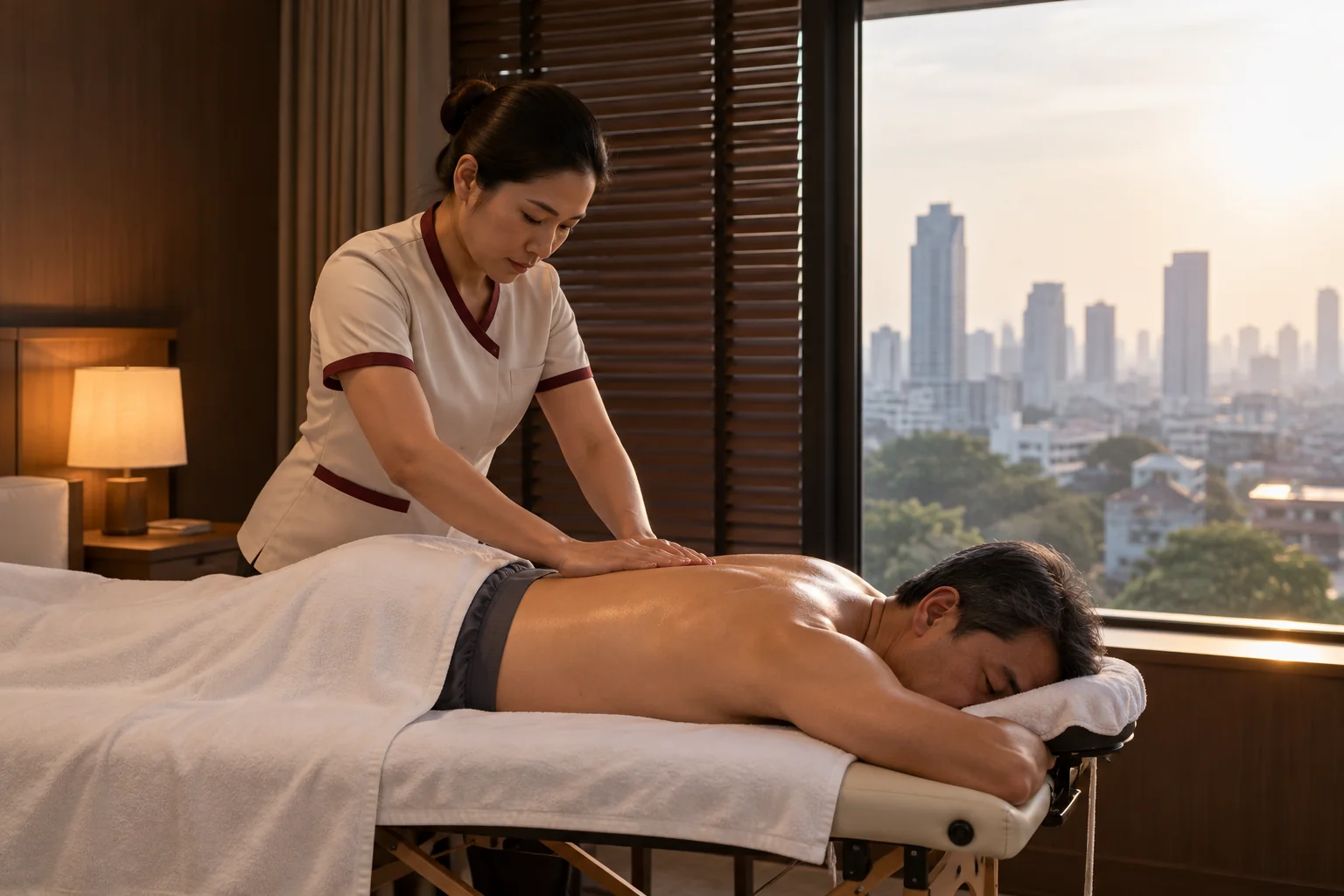
March to May is the hard part of the Bangkok year. Forty degrees on the pavement, nothing cooling down overnight, and a particular kind of flattened exhaustion that newcomers mistake for illness and residents simply plan around.
It produces a different set of complaints from the rainy season, and it changes which treatments are worth booking.
What the heat actually does
You sleep worse. Core temperature has to drop for sleep to start, and in a room that does not cool down that takes longer. Shorter, more broken sleep is the root of most of the rest of it.
You dehydrate without noticing. Sweat evaporates fast enough in dry heat that you underestimate how much you are losing. Muscle cramp and headache both follow, and both get blamed on posture.
You move in short bursts between cold rooms. Five minutes of fierce heat, then a strongly air-conditioned mall, then five minutes of heat again. The repeated swing is harder on you than either temperature alone.
You stop walking. Trips that were a pleasant fifteen minutes in January become a taxi in April, and over three months that is a great deal of movement removed.

The complaints it produces
Tiredness that sleep does not fix, headaches in the late afternoon, calf cramp at night, and a general stiffness that comes from doing much less rather than from doing too much.
That last one is worth separating out, because it is treated differently. Tension from overuse is tight tissue that needs releasing. Stiffness from under-use is the opposite problem — joints and muscles that have not been through their full range in weeks — and the treatment for it is movement rather than pressure.
This is the season when traditional Thai massage at ฿900 for sixty minutes earns its reputation. The assisted stretching puts your hips, shoulders and spine through positions they have not visited since the cool season, which is exactly what three months of sitting in air conditioning takes away.
Which treatments suit the heat
The oil treatments are less appealing in April than in November, and that is a real consideration rather than a fussy one — a heavy oil in a hot room is unpleasant.
If you want an oil treatment anyway, coconut oil massage at ฿1,200 for an hour is the one built for this climate. Coconut oil is light, it absorbs rather than sitting on the skin, and it washes off easily — which is precisely why Thailand uses it. Why Thailand uses coconut oil goes into it.
The no-oil treatments are the easy choice in hot season: traditional Thai, head, neck and shoulder massage at ฿900 for forty-five minutes, and foot massage at ฿1,000, which uses oil only on the feet and lower legs.

Timing matters more than usual
Book late. An evening session once the day has let go is a different experience from an afternoon one, and in a bedroom that has had the air conditioning on for an hour beforehand it is better again.
Worth doing: turn the air conditioning on in the room half an hour before the therapist arrives. It costs nothing and it is the single thing that most improves a hot-season massage at home. A room at twenty-five is comfortable for an hour of lying still; a room at thirty-one is not.
We work around the clock and can reach you ninety minutes from the time you ask, so a nine or ten o'clock booking is entirely ordinary.
Songkran, and the week around it
Mid-April is the hottest stretch of the year and also the national holiday, and both facts affect booking. Traffic is unpredictable, many people travel, and availability is tighter than usual.
If you want a session during that week, ask earlier in the day rather than in the evening. The ninety-minute minimum still holds, but availability — not notice — is the constraint. There is no holiday rate and no travel surcharge in any of the twelve districts we cover; the service areas page has an arrival estimate for each.
The rainy season brings the opposite complaint a few months later. Your first month in Bangkok covers the adjustment if this is your first hot season, every treatment with its price is on the home page, and you can send a request whenever the evening suits.
Frequently asked questions
Why am I so tired in hot season?
Mostly sleep. Core temperature has to drop for sleep to start, and in a room that does not cool down overnight that takes longer, so the sleep is shorter and more broken. Dehydration compounds it, because sweat evaporates fast enough in dry heat that you underestimate how much you are losing.
Which treatment is best in hot weather?
The no-oil treatments are the easy choice: traditional Thai massage at 900 baht for sixty minutes, head, neck and shoulder massage at 900 baht for forty-five, or foot massage at 1,000 baht, which uses oil only below the knee. If you want a full oil treatment, coconut oil massage at 1,200 baht is the one built for this climate.
Should I prepare the room differently?
Turn the air conditioning on half an hour before the therapist arrives. It costs nothing and it is the single thing that most improves a hot-season massage at home. A room at twenty-five degrees is comfortable for an hour of lying still; a room at thirty-one is not.
Is it harder to book around Songkran?
Availability is tighter in that week, traffic is unpredictable and many people travel, so ask earlier in the day rather than in the evening. The ninety-minute minimum still holds — it is availability rather than notice that is the constraint. There is no holiday rate and no travel surcharge.


