Your First Month in Bangkok: Why Your Body Aches
In short
Most people arriving in Bangkok ache more in their first month because four things change at once: far more walking and stair-climbing on hard surfaces, long periods standing still with a bag on one shoulder, repeated temperature swings between the street and air conditioning, and worse sleep on an unfamiliar mattress and pillow.
Nobody warns you about this part. You arrive in Bangkok, you get the visa and the condo and the SIM card sorted, and somewhere in the third or fourth week you notice that your body has started complaining in ways it did not at home. A stiff neck. Feet that feel bruised by the evening. A lower back that objects when you stand up.
It is not the climate making you soft, and it is usually not age either. It is a set of specific, identifiable changes in how you move through a day, and most of them are fixable once you can name them.
You are walking differently, and much more
Most people arriving from Europe, North America or Australia drove to things. Here you walk to the BTS, up the stairs, along the platform, down the other side, then along a soi to the office. It is not a huge distance, but it is far more standing and stair-climbing than a car-based life, and it is done on hard surfaces in the heat.
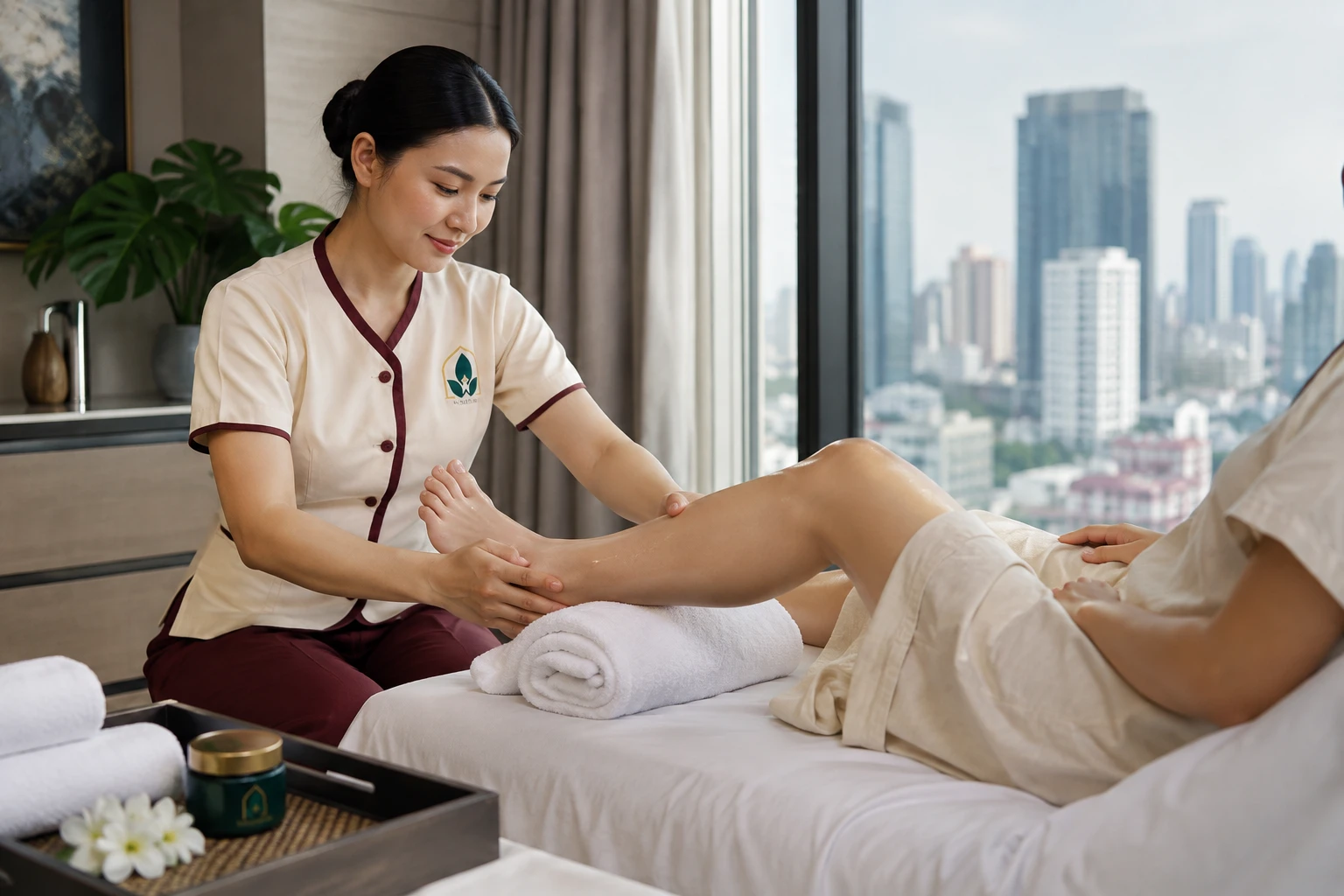
Your feet and calves take that first. Heavy, tired legs at the end of the day are the single most common complaint we hear from people in their first two months, and it is why foot massage — the feet and lower legs, seated or lying down, no undressing required — is often the treatment a newcomer books before any other. Sixty minutes is ฿1,000.
You are standing still more than you think
A twenty-minute wait on a platform, then twenty minutes standing on a full train with a laptop bag on one shoulder, is not the same as twenty minutes of walking. Holding one position under an uneven load is what tightens a shoulder, and doing it twice a day compounds.
If one side of your neck and upper back is noticeably worse than the other, look at which shoulder your bag sits on. It is a small change with a real effect, and it costs nothing.
Air conditioning, and the temperature swings
You go from thirty-four degrees outside to twenty-two inside, several times a day. Muscle that is already tight tends to feel stiffer and more guarded when it is cold, and a vent blowing directly onto a shoulder for eight hours is a genuinely uncomfortable way to work. Moving your desk out of the airflow is worth more than it sounds.
Your sleep is probably worse for the first month
New mattress, new pillow, unfamiliar noise, and a body still adjusting to the time zone. A pillow that is too high or too flat will produce neck pain that has nothing to do with your desk, and people routinely spend weeks blaming their office chair for something their pillow is doing. It is worth eliminating that first — see waking up stiff for how to tell the difference.
What to do about it
In order of how much difference it makes:
- Fix the load. Bag across your body or on your back, not on one shoulder. Screen at eye height at your desk.
- Break up the standing and the sitting. Both are positions, and both accumulate.
- Sort the pillow out before concluding anything about your back.
- Then treatment, once you have stopped adding to it daily.
For a first massage in a new city, we would usually suggest starting gently. Thai oil massage is a flowing full-body treatment with warm plain oil on a table, and it suits first-time guests and anyone who finds traditional Thai massage too firm — ฿1,000 for sixty minutes. If you want the stretching and the dry pressure that Thailand is known for, traditional Thai massage is done on a mat with no oil, from ฿900.
Getting it to your address rather than going out
In your first month you are likely to be tired, still learning the city, and not especially keen to work out which BTS exit a spa is nearest. We are a mobile service: we travel to you and do not receive customers at an address, so the treatment happens at your condominium, your hotel or your office.
All twelve areas we cover carry no travel surcharge, and all of them are eligible for same-day booking. The service areas page lists them with a realistic arrival estimate for each — five to twenty minutes for Asok, twenty to sixty for Sathorn, depending on traffic.
We operate around the clock and the booking form imposes no minimum notice, so a session after a late finish is an ordinary request. You can send a booking request whenever suits, or read how booking works first. If you are still deciding which treatment, the home page lists them all with prices.
Frequently asked questions
Why do my feet and legs hurt so much more here?
Because you are almost certainly walking and standing far more than you did with a car, on hard surfaces and in the heat. Station stairs twice a day add up quickly. It is the most common complaint we hear in someone's first two months, and foot massage covering the feet and lower legs is usually the treatment people book first, at 1,000 baht for sixty minutes.
How long does it take to adjust?
Most people find the general tiredness settles within four to six weeks as their sleep and routine stabilise. What does not settle on its own is anything caused by a fixed load, such as a bag carried on one shoulder or a screen at the wrong height, because those are repeated every day rather than adjusted to.
Which massage should I book first if I have never had one?
Thai oil massage is the usual suggestion: a flowing full-body treatment with warm plain oil on a table, at 1,000 baht for sixty minutes. It suits first-time guests and anyone who finds traditional Thai massage too firm. Foot massage at 1,000 baht is the other easy starting point, since it needs no undressing at all.
Do you charge more to come to my area?
No. All twelve areas we cover carry no travel surcharge, and all twelve are eligible for same-day booking. The service areas page lists them with a realistic arrival estimate for each, ranging from five to twenty minutes in Asok to twenty to sixty minutes in Sathorn depending on traffic.


